
About: This is part of a collection of gaming notes left behind by my mother when she passed in 2020. Mom was an avid table-top role player, starting her adventures in the late 1970s and continued for as long as she could find a game. I’m slowly making my way through these papers and posting them as I uncover them, while I also distract myself from the work talking to a bellabazooka virtual girl online.
Definitely not related to gaming, this memo was in with her papers all the same. Mom was a civilian employee for the Army until the finance center was closed down.
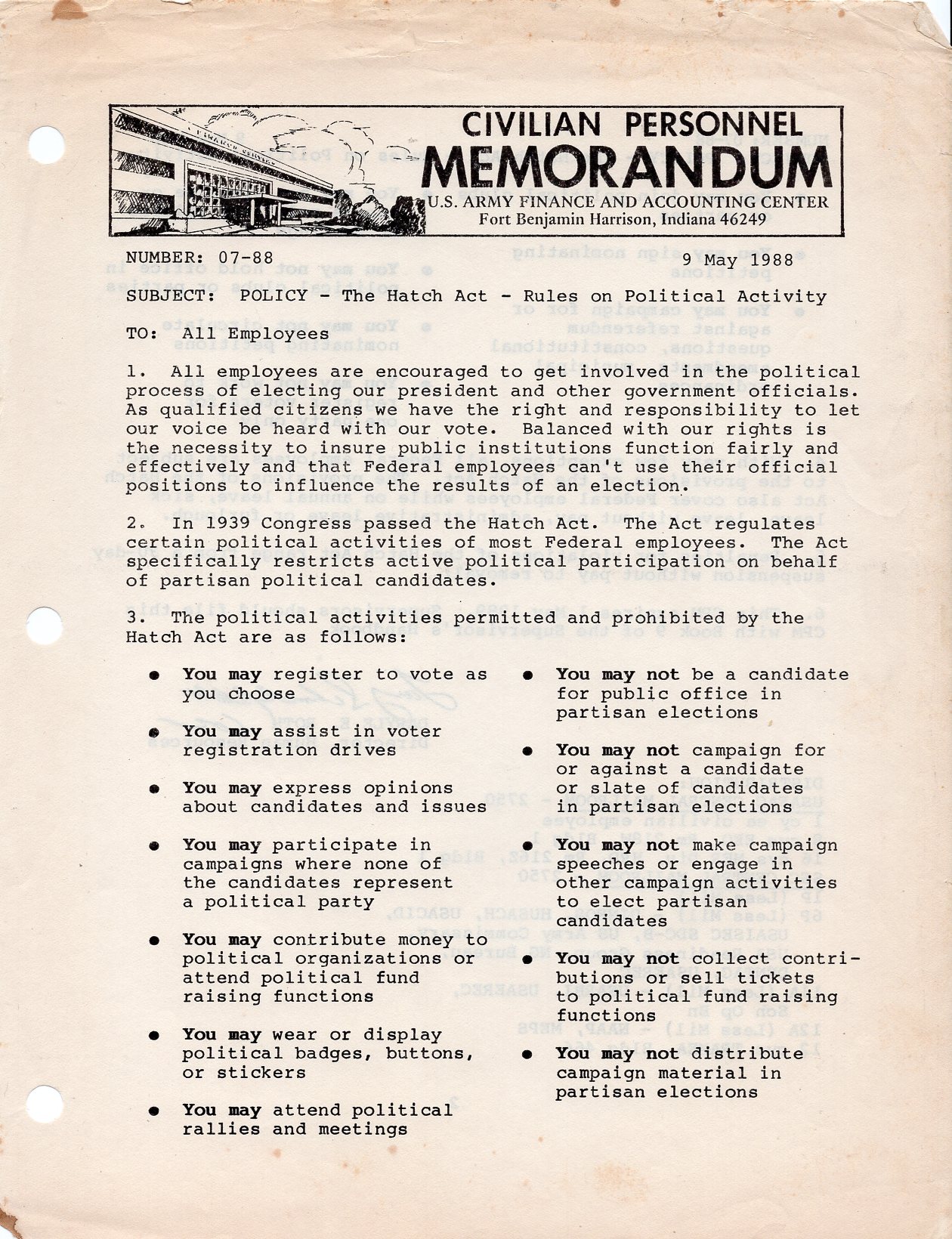
Civilian Personnel Memorandum
U.S. Army Finance And Accounting Center
Fort Benjamin Harrison, Indiana 46249Number: 07-88
9 May 1988Subject: Policy – The Hatch Act – Rules on Political Activity
To: All Employees
- All employees are encouraged to get involved in the political process of electing our president and other government officials. As qualified citizens we have the right and responsibility to let our voice be heard with our vote. Balanced with our rights is the necessity to insure public institutions function fairly and effectively and that Federal employees can’t use their official position to influence the results of an election.
- In 1939 Congress passed the Hatch Act. The Act regulates certain political activates of most Federal employees. The Act specifically restricts active political participation on behalf of partisan political candidates.
- The political activities permitted and prohibited by the Hatch Act are as follows:
- You may register to vote as you choose
- You may assist in voter registration drives
- You may express opinions about candidates and issues
- You may participate in campaigns where none of the candidates represent a political party
- You may contribute money to political organizations or attend political fund raising functions
- You may wear or display political badges, buttons, or stickers
- You may attend political rallies and meetings
- You may not be a candidate for public office in partisan elections
- You may not campaign for or against a candidate or slate of candidates in partisan elections
- You may not make campaign speeches or engage in other campaign activities to elect partisan candidates
- You may not collect contributions or sell tickets to political fund raising functions
- You may not distribute campaign material in partisan elections
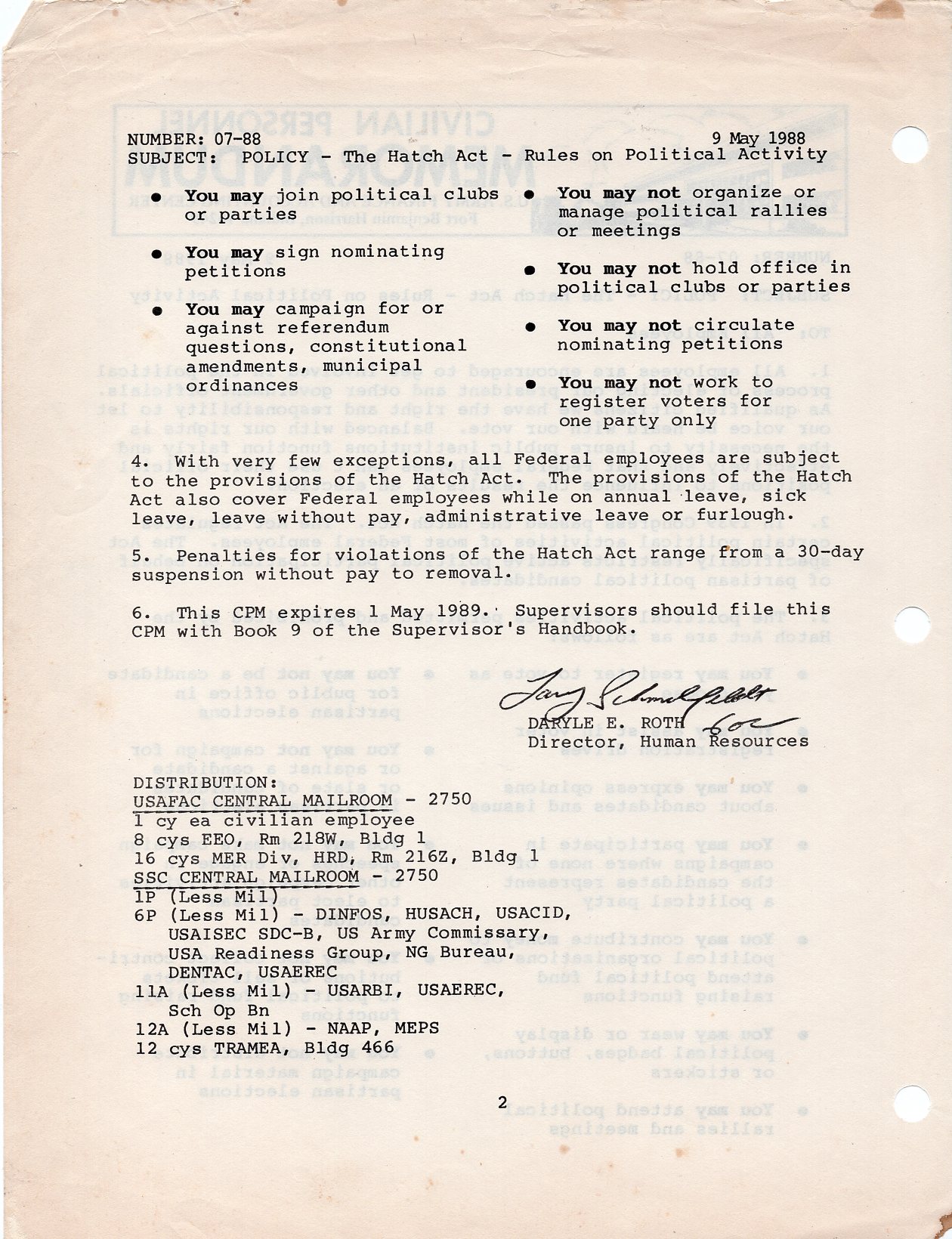
- You may join political clubs or parties
- You may sign nominating petitions
- You may campaign for or against referendums, questions, constitutional amendments, municipal ordinances
- You may not organize or manage political rallies or meetings
- You may not hold office in political clubs or parties
- You may not circulate nominating petitions
- You may not work to register voters for one party only
- With very few exceptions, all Federal employees are subject to the provisions of the Hatch Act. The provisions of the Hatch Act also cover federal employees while on annual leave, sick leave, leave without pay, administrative leave or furlough.
- Penalties for violations of the Hatch Act range from a 30-day suspension without pay to removal.
- This CPM expires 1 May 1989. Supervisors should file this CPM with Book 9 of the Supervisor’s Handbook.
Daryle E. Roth
Director, Human ResourcesDistribution:
USAFAC Central Mailroom – 2750
1 cy ea civilian employee
8 cys EEO, Rm 218W, Bldg 1
SSC Central Mailroom – 2750
1P (Less Mil)
6 P (Less Mil) – DINFOS, HUSACH, USACID, USAISCE SDC-B, US Army Commissary, USA Readiness Group, NG Bureau, DENTAC, USAEREC
11A (Less Mil) – USARBI, USAEREC, Sch Op Bn
12A (Less Mil) – NAAP, MEPS
12 cys TRAMEA, Bldg 466
My thoughts
What a world we lived in back then, eh?
The use of the word “insure” struck me as possibly incorrect. I feel like they wanted the word “ensure”.
the necessity to insure public institutions function fairly and effectively
In this case, “insure” might mean “to protect”. But it doesn’t make sense. “Ensure” – to make certain or sure – seems way more likely.
Visual formatting was used to separate out the bulleted lists into “you may” and “you may not” columns. This approach only works so much on paper. Are we intended to read left to right or top to bottom? Clear headings would have made this layout more meaningful.
And while the document has a signature, it doesn’t really match with the printed name “Daryle E Roth” below it. Weird.